If you’ve spent much time on fitness social media recently, you’ve probably seen a screenshot about someone’s zone 5 heart rate. You know the ones with a workout summary showing a bright red bar stretching across the screen. Usually accompanied by some questionable brag about spending “two hours in the red zone” or “crushing a full marathon in Zone 5.”
These can be attention-grabbing stats because they look pretty impressive, like a badge of toughness. But, from a scientific standpoint, it’s important to know that this is a physical impossibility.
A ‘harder is always better’ ethos has long been a persistent idea in the fitness world, and the mindset that the ‘red zone is where the real work happens’ fits this mentality all too easily. In turn, it leads performance-oriented athletes to believe that if they aren’t suffering in a zone 5, then they aren’t working hard enough. However, it’s actually this mistaken equation between zone 5 and achievement (rather than a specific physiological state) that can derail your training.
So, let’s get real: Can you stay in heart rate Zone 5 for an hour? Physiologically, the answer is no. For the vast majority of athletes, a true zone 5 effort — working at VO2max intensity — can only be sustained for 3 to 10 minutes. If your wearable data shows you training or competing in zone 5 for an hour or more, your heart rate zones are likely miscalculated, or your device is tracking something other than your true physiological peak.
The truth is that your body has hardcoded metabolic limits. While zone 5 is a powerful tool for building speed and increasing your aerobic ceiling, it’s not a sustainable state. To get the most out of your performance, you need to look past the social media noise, debunk this ‘harder is better’ myth, and understand exactly why you ‘bonk’ when you try to push past your limits.
What is (the real) zone 5?
To understand why those “two-hour zone 5” claims aren’t exactly factual, we first have to define what the ‘red zone’ actually is. In a standard five-zone model, zone 5 is the maximum effort zone for your heart rate, the peak of the pyramid, typically defined as 90% to 100% of your maximum heart rate. But remember, zone 5 isn’t just a number on a screen; it’s a physiological state.
The physiological border: crossing the threshold
The real gateway to zone 5 is a point known as Lactate Threshold 2 (LT2), often called the anaerobic threshold. To help you understand this, it’s best to think of your body like an engine. In zones 1 through 4, your aerobic system is the primary fuel source; you’re breathing in enough oxygen to meet the energy demands of your muscles. However, once you cross the LT2 border into zone 5, the demand for energy outstrips your oxygen supply. So, your body pivots to its anaerobic systems, burning fuel so quickly that it produces metabolic byproducts — specifically lactate and hydrogen ions — faster than your system can clear them.
How it feels: total breathlessness
In the world of sports science, we often use the ‘talk test’ to determine intensity. Here’s what the different heart rate zones normally feel like:
- Zone 2: You can carry on a full conversation.
- Zone 4: You can speak in short, choppy sentences.
- Zone 5: Speech is no longer an option.
When you are truly in zone 5, you’re gasping for air. You might be able to grunt a single word, but your respiratory system is working at its absolute limit to get oxygen to your laboring muscles and to blow off carbon dioxide. It’s an all-out level of intensity — the kind of effort you’d use for a final 400-meter sprint to the finish line or a grueling set of hill repeats.
If you’re running a marathon and have the lung capacity to check your watch, wave to the crowd, or maintain a steady stride for miles on end, you aren’t in zone 5. You’re likely in high zone 4, which is a very different physiological neighborhood.
What happens when you reach zone 5?
If you’ve ever tried to run anywhere fast or climb a steep hill, you would have experienced that moment when your legs suddenly turn to lead while your lungs suddenly feel like they’re on fire. In the endurance world, this is called ‘bonking’ or ‘hitting the wall,’ but in zone 5 this happens after a few minutes, not hours.
When you push your body to this level of intensity, your body undergoes a series of rapid, unavoidable physiological shifts that act as a built-in speed limiter. They’re the reason why you can’t simply ‘power through’ a true zone 5 effort for long.
Lactate
Think of your body’s ability to handle lactate as similar to a sink: it can handle a certain amount, but only up to a point. In the lower heart rate zones, your faucet (lactate) runs at a trickle at first and then with ever-increasing pressure, while the drain (your body’s ability to clear and reuse lactate) clears it away immediately. However, in zone 5, the faucet is turned on full blast, and so the sink begins to overflow, meaning you’re working above your LT2 and you’re producing lactate faster than your body can clear it.
So, what happens? Once the ‘sink’ overflows, the accumulation of metabolic byproducts — specifically hydrogen ions — causes the pH level in your muscles to drop. This leads to acidosis, which interferes with the enzymes responsible for energy production. Put simply, your muscles physically lose the ability to contract with power.
Oxygen debt and VO2max
In zone 5, you are operating at or near your VO2max — the absolute maximum amount of oxygen your body can utilize. At this ceiling, your heart and lungs are maxed out, yet your muscles are still demanding more energy than the oxygen you’re breathing in can provide.
This creates an oxygen debt. Your body can bridge this gap using anaerobic energy (fueling without oxygen) for a short burst, but it’s an expensive loan with high interest. Within minutes, the mismatch between oxygen demand and supply becomes unsustainable, forcing you to slow down or stop.
The myth of elite resilience
You might think elite marathoners have found a secret way to power along in zone 5. They haven’t. While professional athletes have a much higher ‘ceiling’ — meaning their zone 4 pace might be faster than a beginner’s sprint — they’re subject to the same laws of physics.
Research on “physiological resilience” (e.g., Jones, 2023) shows that even the most fit humans experience a rapid decline in power once they cross their critical threshold. Elites aren’t running marathons in zone 5; at most, they’re running them at a very high percentage of zone 4. The moment they tip into true zone 5, the countdown to exhaustion starts, regardless of their medal count.
The gray area: why your data is ‘lying’ to you
If you physiologically can’t survive in zone 5 for more than a few minutes, why does your training app occasionally congratulate you on a 60-minute zone 5 session?
No, it’s not because you’ve discovered a hidden human superpower. It’s simply that if your wearable device is fed the wrong parameters, it will give you the wrong conclusions. Here are the three most common reasons for the ‘gray area’ in your data.
The flaw of the ‘220-age’ formula
Many fitness trackers default to the standard formula (220-age) to estimate your maximum heart rate (Max HR). For many performance-oriented athletes, this estimate is wildly inaccurate. If the formula predicts your Max HR is 180, but your true, tested Max HR is actually 195, your watch will think you’re redlining in zone 5 whenever you hit 165 bpm. In reality, you’re just having a solid zone 3 or 4 workout.
The threshold shift
As you get fitter, your LT2 rises. A well-trained runner can often sustain an effort at 85% to 90% of their Max HR for an hour or more — this is the sweet spot for half-marathons. So, if your watch hasn’t been updated to reflect your improved fitness, it will mislabel this high-end endurance as zone 5. That means you aren’t ‘living in the red’; your ‘yellow zone’ (zone 4) is simply higher than the software realizes.
Cardiac drift and hardware hiccups
Physiology isn’t static. In a long race, factors like dehydration and rising body temperature can cause cardiac drift — where your heart rate slowly climbs even if your pace stays the same. By mile 20 of a marathon, your heart might be beating at zone 5 speeds, but your muscles are producing zone 3 power.
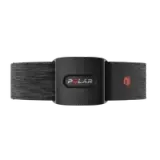
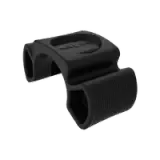
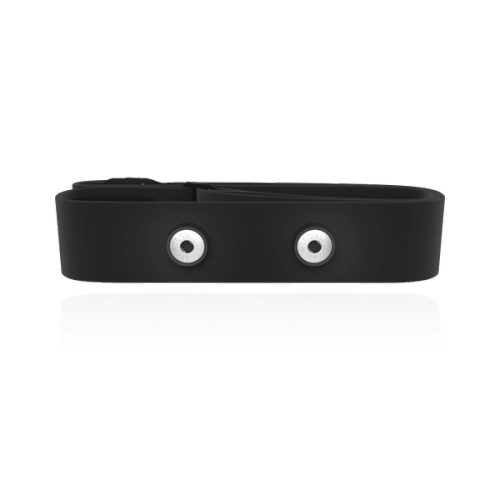
Additionally, wrist-based optical sensors can suffer from cadence lock, where the sensor mistakenly tracks the rhythmic ‘thump-thump’ of your feet hitting the pavement instead of your actual pulse. This is why serious athletes rely on the ECG-level precision of a chest strap like the Polar H10 to distinguish between actual intensity and data ‘noise.’
Why training in zone 5 matters
If you can only sustain it for a few minutes, why bother with zone 5 at all? Because those few minutes offer you some of your most potent training time.
Think of zone 5 not as a place to live, but as a tool that really comes in handy occasionally. You don’t need it for every session — in fact, you shouldn’t — but when used strategically, it triggers adaptations that lower intensities simply can’t touch.
Raising the ceiling: VO2max adaptations
The primary goal of zone 5 training is to increase your VO2max or your aerobic ceiling. By pushing your cardiovascular system to its absolute limit, you force your heart to pump more blood per beat (stroke volume) and your muscles to become more efficient at extracting oxygen. When you raise the ceiling, every zone below it becomes faster. Your ‘easy’ pace gets quicker, and your marathon pace feels more sustainable.
Building metabolic buffering
Remember that sink analogy above? Training in zone 5 teaches your body how to handle that overflow. Regularly exposing your muscles to high levels of lactate and acidity through training improves your metabolic buffering capacity. You aren’t just getting faster; you’re teaching your body how to maintain power even when the ‘burn’ starts to set in.
Neuromuscular power and fast-twitch recruitment
At this intensity, your brain recruits your Type II (fast-twitch) muscle fibers, which are responsible for explosive power and speed. Even for marathoners, hitting zone 5 during your training (such as in interval sessions) improves running economy and that last surge at the finish line.
Rare frequency
As zone 5 is so taxing on the central nervous system, it requires significant recovery. Most elite training plans follow a ‘polarized’ or 80/20 model: 80% of your runs are easy (zone 1–2), and only a small fraction of the remaining 20% is spent in zones 4 or 5. That means, if you try to hit the red zone every day, you aren’t getting faster — you’re just getting tired. True zone 5 effort has a place in every training plan, but think of it as a seasoning, not the main course.
How to calculate your true zone 5
As you can see, it’s best to stop relying on generic formulas. If you want to train like a professional, you need data that reflects your unique physiology, not a statistical average. Finding your true zone 5 requires moving away from the ‘220-age’ guesswork and toward real-world performance metrics.
The lab vs. the field
While a laboratory-grade test is the gold standard for measuring your VO2max, most of us don’t have access to a sports science lab whenever our fitness improves. Fortunately, your body provides all the data you need if you know how to ask for it.
A field test — where you run at increasing intensities until you hit a physical limit — is the most practical way to find your actual maximum heart rate and your individual threshold.
undefined

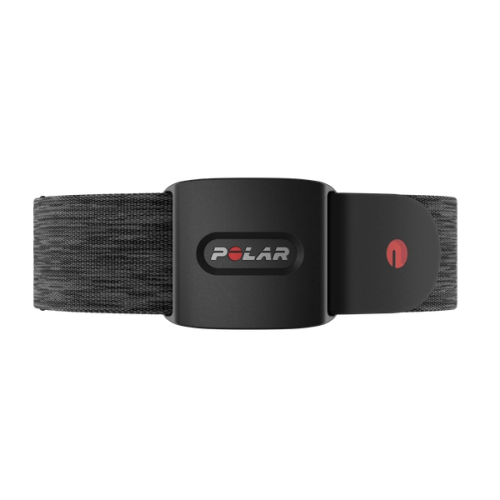
Polar H10
Heart Rate Sensor
When it comes to accuracy and connectivity, Polar H10 heart rate sensor is the go-to choice. Monitor your heart rate with maximum precision and connect your heart rate to a great variety of training devices with Bluetooth® and ANT+.
Guided precision: the Polar Running Performance Test
Say goodbye to the guesswork. Polar’s Running Performance Test is a structured, guided tool designed to help you safely push toward your limits to define your heart rate zones.
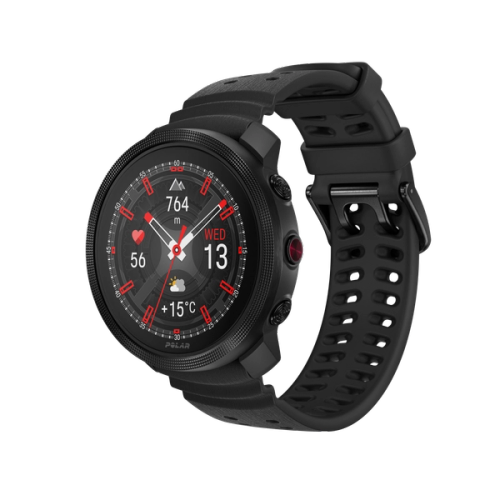
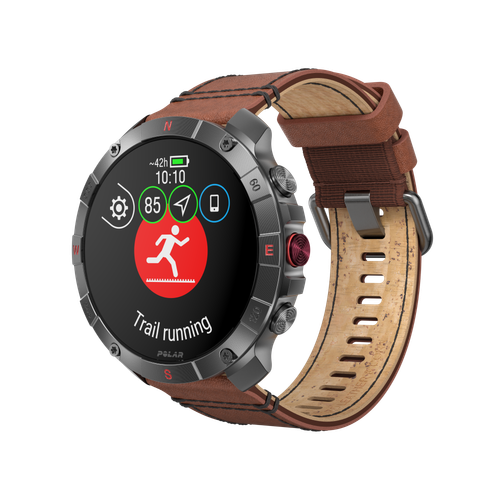
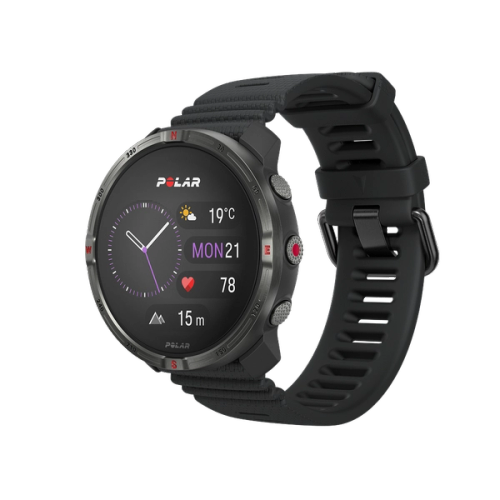
Instead of an all-out, disorganized sprint, the test guides you through a progressive ramp-up. It monitors your heart rate response to determine your maximal aerobic power and your Max HR. Once completed, your watch automatically updates your training zones. This ensures that when your watch says you’re in zone 5, it’s because you are actually hitting that VO2max intensity, not because a formula failed you.
Your golden rule for identifying zone 5
A simple way to tell if you’re in zone 5 is to see how long you can sustain your intensity. If you can keep going for over 10 minutes, then you’re at your lactate threshold (zone 4). If you can only sustain something for 3–10 minutes and then feel physically unable to take another step, congratulations. You’ve found zone 5. Let this be your reality check.
Respect the red zone
Ultimately, you should think of zone 5 as a surgical tool, not a sledgehammer. It’s a high-intensity, high-reward stimulus that triggers the deep adaptations necessary to raise your ceiling and improve your speed. However, it is not a place to spend lots of time, and it’s certainly not a zone you can — or should — maintain for the duration of a marathon.
Remember, to get the most out of these peak efforts, you have to respect the 80/20 Rule. Most of your training (roughly 80%) should be performed at a low, easy intensity, primarily in zone 2. This builds the aerobic base and metabolic efficiency required to handle the ‘burn’ of high-intensity work. By keeping your easy runs truly easy, you ensure you have the ‘fuel’ and central nervous system recovery necessary to execute true zone 5 sessions with the intensity they demand.
By understanding the metabolic limits of your body, you can stop chasing brag-worthy social media screenshots and start chasing real performance gains. Use the red zone sparingly to trigger specific adaptations, and always prioritize physiological truth over data noise.
Ready to stop guessing? Use the Polar Running Performance Test and pair it with a Polar H10 to ensure your peak efforts are actually hitting the mark.
Enjoying this article? Subscribe to the Polar Newsletter and get notified when new articles are out.
Subscribe



 POLAR Street X
New
POLAR Street X
New
 Polar Vantage M3
 Polar Grit X2 Pro Titan
 Polar Grit X2 Pro
 Polar Grit X2
 Polar Vantage V3
 Polar Ignite 3
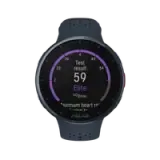 Polar Pacer Pro
 Polar Pacer
 Polar Unite
Grit X Series
Vantage Series
Pacer Series
Ignite Series
Polar Unite
Grit X Series
Vantage Series
Pacer Series
Ignite Series